This was the location below that spoke to me. This picture was taken after it was removed though; I couldn’t find an earlier picture like the way this one looked. This place would be named ‘Hero’, after the poem I would write on the bench. …And I apologize again for not publishing each poem.
Read the lyrics of the music you listen to, and let the words define categories into which you collect all of those related nuances. Then you take the content from a category and arrange it into a poem. There are some other rules and guidelines that I follow when doing that so perhaps I’ll write a short blog about it sometime. You could produce the same kind of thing yourself. It can even make you aware of the boundaries and limitations of the behavior modeling in your environment, because, as I’ve learned, the nuances are often the things that they do not even mention.
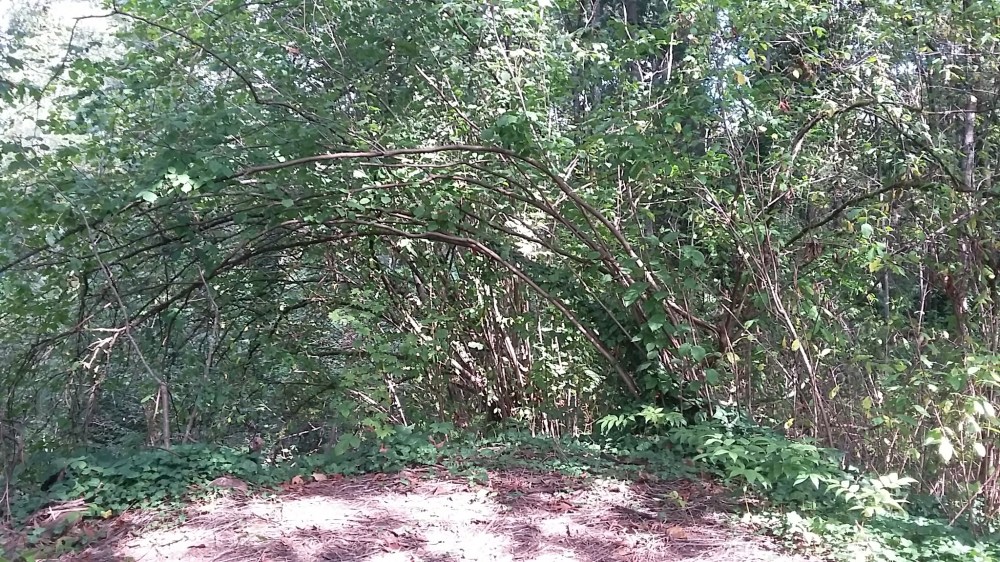
When I first came to this area, there were I think I remember around 15 empty milk jugs all clean and empty with the lids on, together in one pile. I took them all to the recycling, along with any other garbage that I regularly collected. Over time I would discover many other items such as wrist watches, bicycle seats, shredded remains of some fabric, a bed frame, a fully functioning scooter, all kinds of clothing, mattresses, cushions, broken lawn chairs, and some heavy car parts that are still there.
From where this picture above was taken, I am approximately standing on the skeletal remains of a spring coil mattress; that I didn’t know was there for at least a few months. It had seemed like the Ivy was thick and spongy there but I didn’t notice it for a good while. And, there were two couch cushions beside that; that I wouldn’t discover until after the October windstorm of 2015.
From a little further down the trail beside the creek where the next spot will be in part 4 of this blog, there was a single unbroken plastic chair that I brought up here at the beginning of this project.
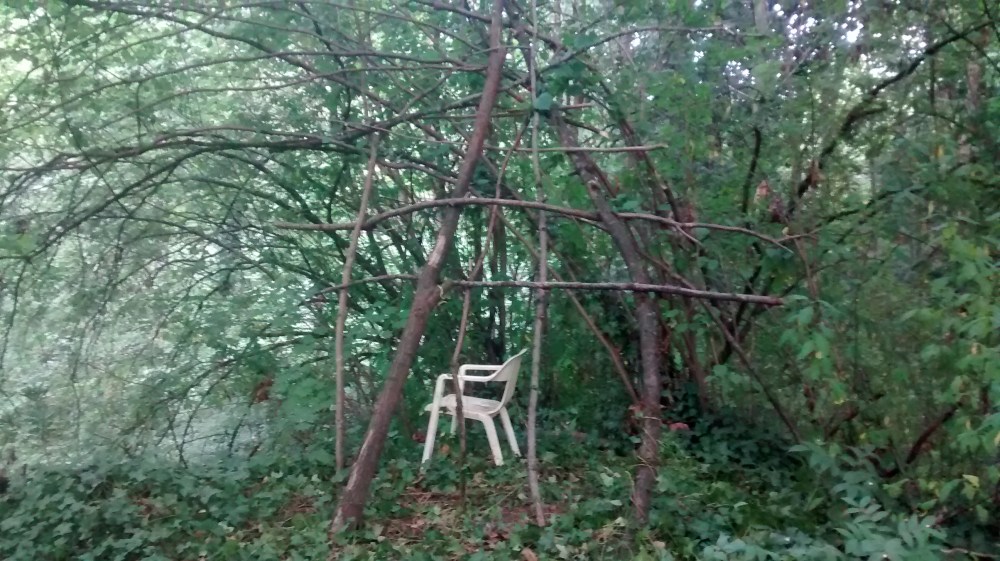
I took from my stick weaving experience on the wall at COG1 and made a sturdy matte structure that was bound under pressure and moved all together. What I learned in hind-site from this project was that it may have first been better to collect all of the materials first. Then they could be sorted by size and shape and could be used more effectively, but since I was collecting only dead wood, I was limited in that regard.
The structure eventually collapsed enough that I dismantled it, and when I did I sorted all the pieces by size and shape but I didn’t get to do the rebuild before it was removed and my sticks were broken and thrown about the area. That would have been a much more interesting looking build. The thing about this little hut is how haunted or surreal it looked.
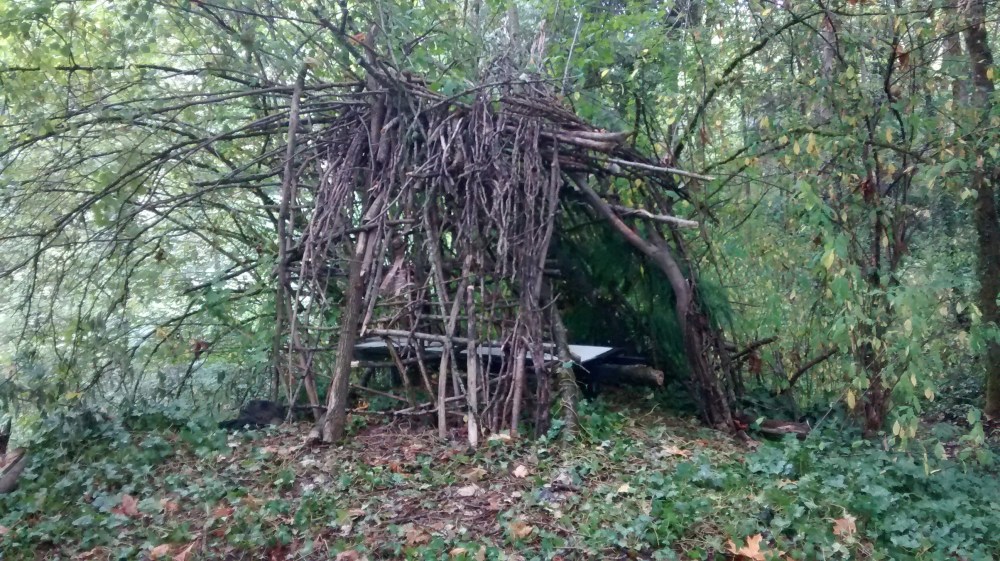
My intention was that the angled branches would catch the rain water and divert it away from the bench. Aside from structural pieces I usually placed the thick butt-end of the branch up at the top. I would add to it by weaving or threading branches into the structure, and which I found to be a very satisfying pass-time. The branches did a pretty good job of keeping the bench dry but in heavy rain it washed the moss and dirt off the branches, falling on the bench.
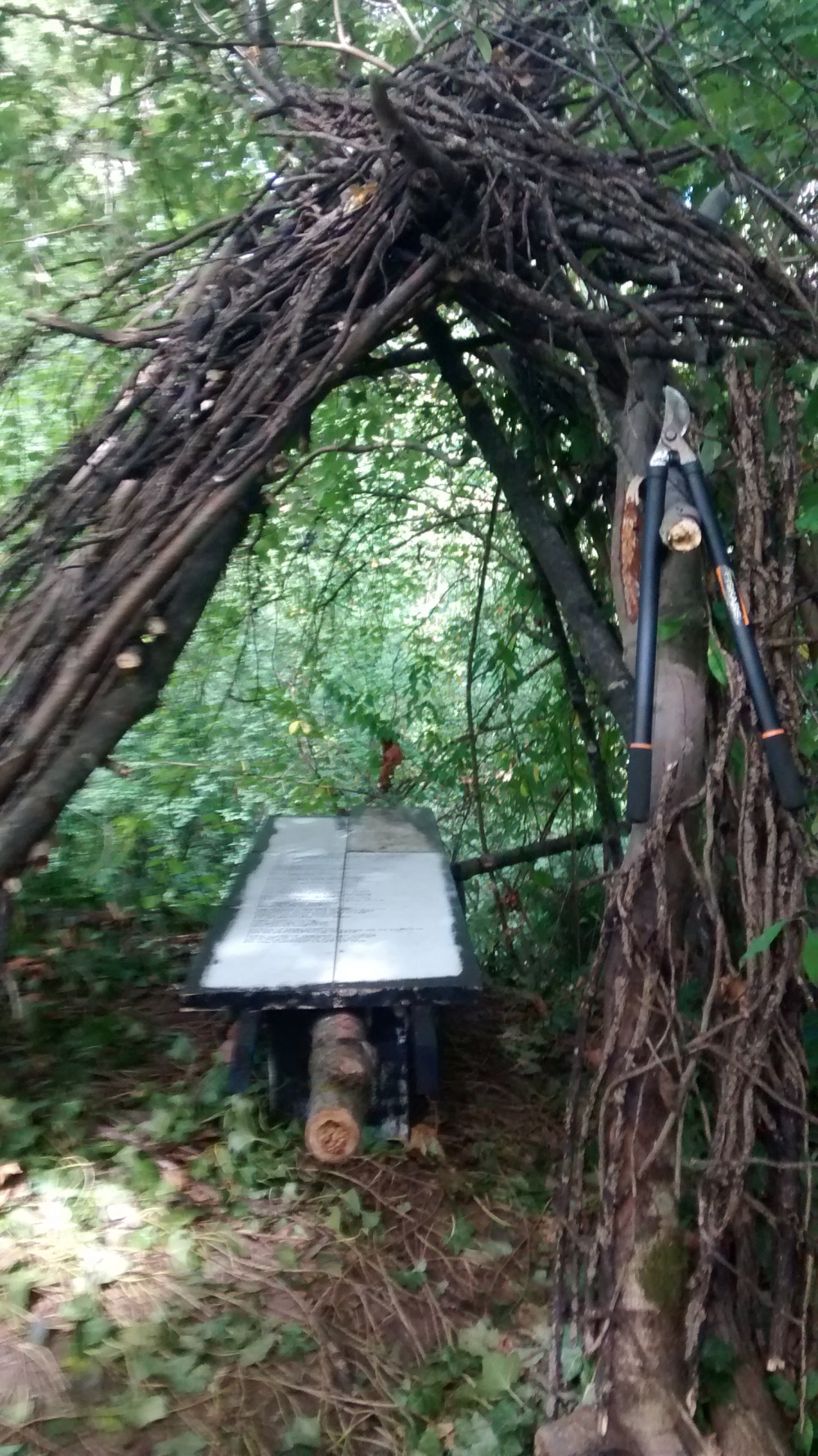
This location was the first time that I had worked with other people on a project. Installing the bench was one of the first things that I did with someone else. It almost always helped create a very good finished product.
All the pieces of the bench were waste cut-offs from work that I did at my job one day; along with some reclaimed garbage wood from the job-site that were of too poor quality to be used for that job. They’re actually quite toxic pieces of wood that have been heavily treated, you don’t even want to burn these boards, and I had never intended to leave them here permanently.
The view was from the top of a very steep embankment and overlooked a creek. I was able to make a place to put my feet on when sitting at the end; that’s the angled piece you can see in the frame below. And by now I had lined the inside with a plastic sheet that was a waste cut-off from a job site.
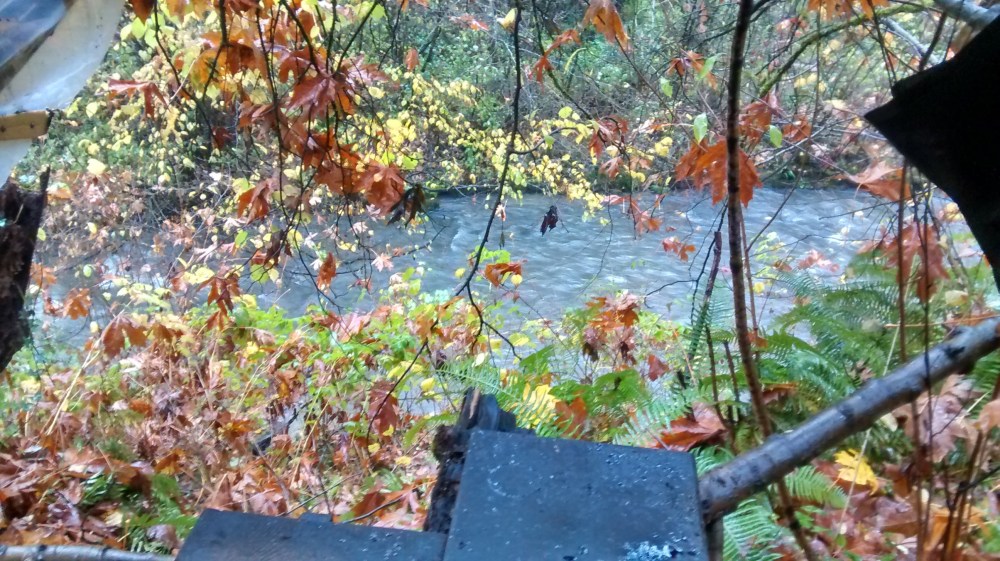
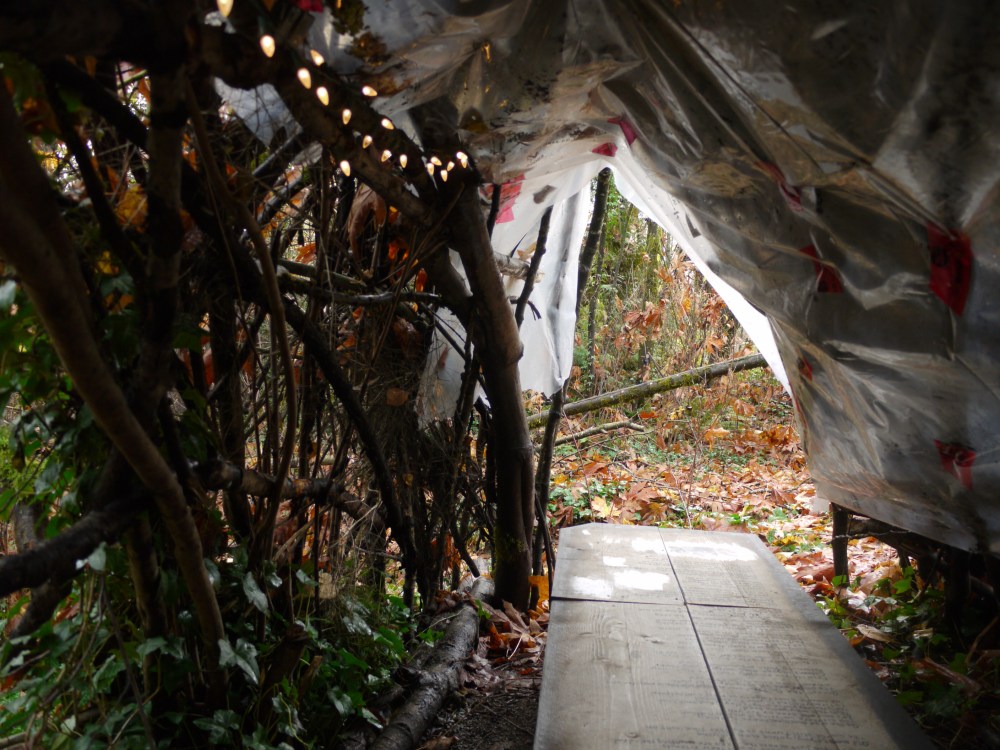
I always made these places open on at least two ends so that no one would ever become trapped inside. Not very many people used this spot but I know that a few did, so it was little maintenance.
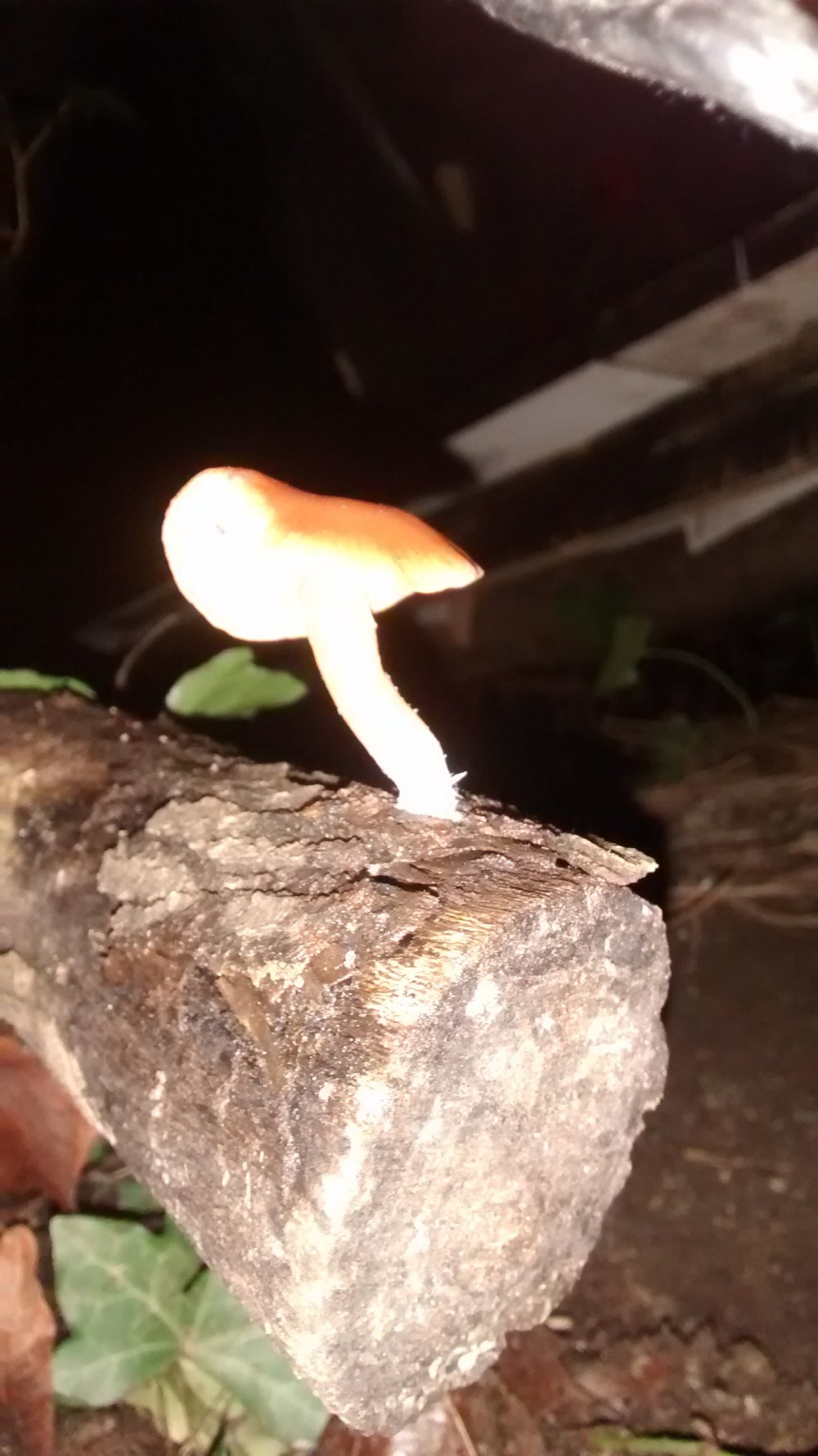
This little mushroom proudly sprouted at the end of a piece of wood that was part of the place. Sorry its not in better detail but it always gave me a good feeling when I saw those instances where I could see life fitting in, in my places.
As this place developed it became much thicker as I kept building it up trying to keep it dry. I would place shorter pieces on top and longer ones on the side, kind of woven in, usually at least a little bit to anchor it in place. At one point I wanted a piece on the inside to hang things on. I sourced the straightest piece I could find and looked for a small hole where I could see straight through the structure. Then I threaded the branch into that hole and made the piece that I wanted, and which was on an angle unlike all the others around it.
Unfortunately, these spots never got to age. The idea here was to pull the growing Ivy up into the structure as it grew. As anything ages it changes slightly in appearance and always continues to ‘fit’ in its environment, it would have looked so nice by now.
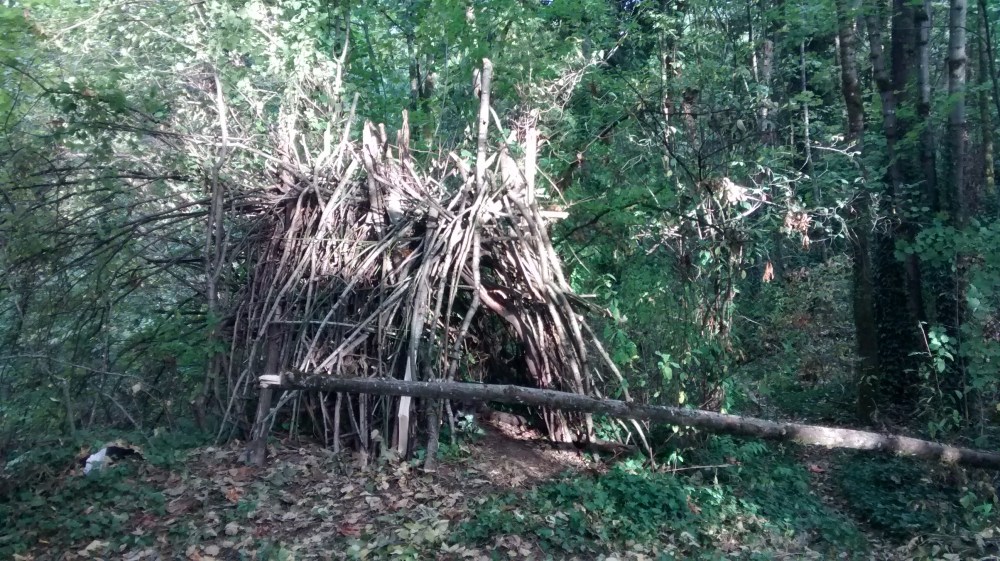
This didn’t last too long in this shape because it would fall over by Christmas if I’m remembering correctly. It only took about one hour to remove and sort all of the pieces into similar groups. Here is a picture of it in the fall, and another with the sorted branches.
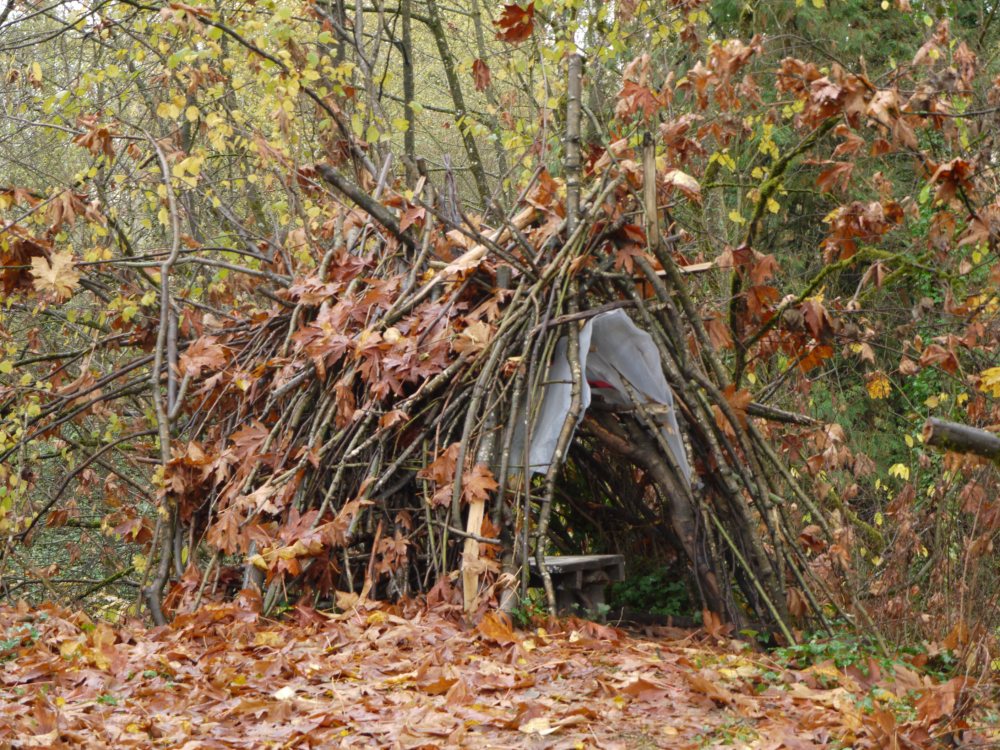
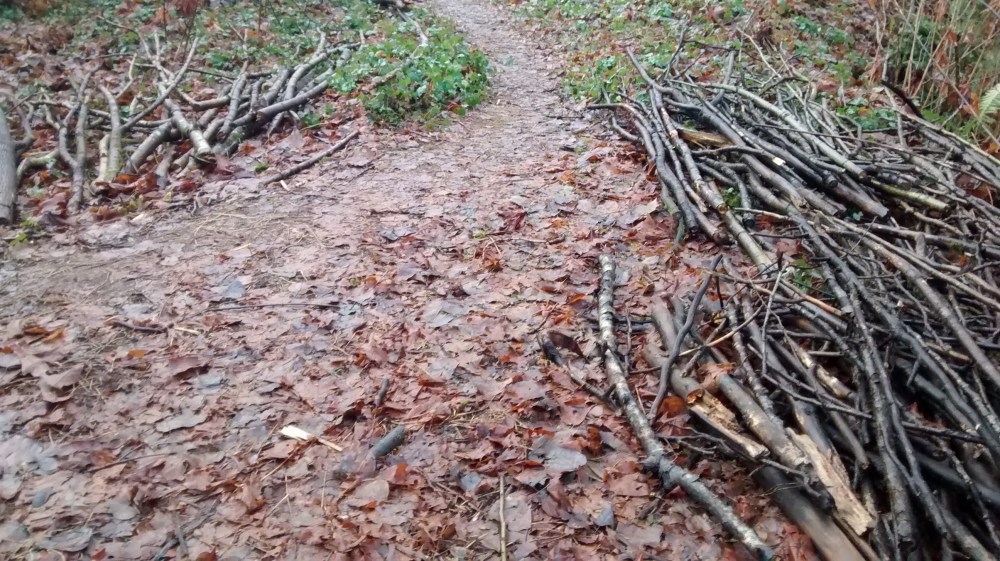
The intention behind these integrations was just simply to practice the process of applying yourself over time by an accumulation of nuanced releases of energy, often fluctuating as I was limited in time, permission, and materials. I found it to be very spiritually fulfilling to work and exercise on these little spots; And I credit them with helping me to achieve an interior calmness that I longed for. That bench was really comfortable to lay on, it was my relaxation period after a long work day. When I sit in nature now I often don’t want to be around other people, so my surviving location is very small and very out of the way.
In my thoughts on redesigning this spot I had envisioned spreading some of those living long branches apart and anchoring some this way so it would appear like a shell, sheltering the seating area. Of course I never got to do that though.
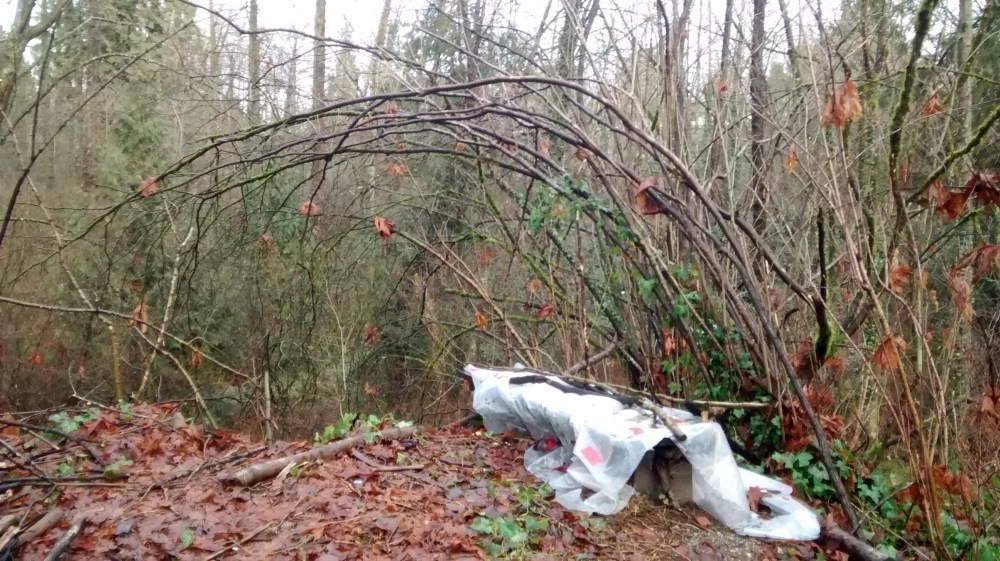
My next place, Sorcerer of Death’s Construction, would be the ‘piece de resistance’ of all these experimental integrations; it would be very popular among locals, as you can see in the image below.
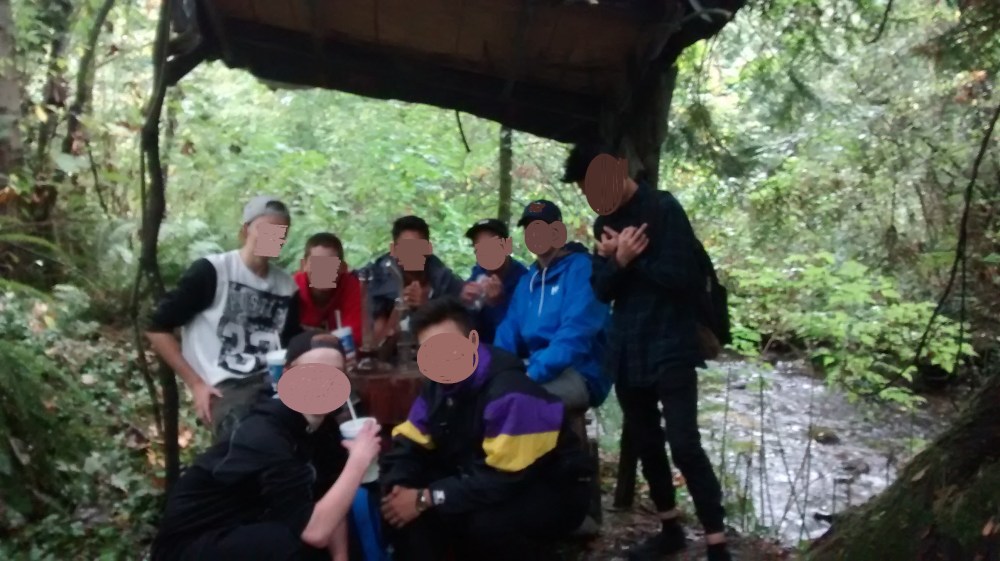
So that brings me to the end of Part III of this series covering my experimental environmental integrations. Look for Part IV of this blog covering the custom creation of the above spot coming soon.
Thank you for reading, and don’t forget to register to follow this blog! Its by the guy who wrote the book on what Hitler knew!
James Paul Bilous; Author of the interesting new book Organism Theory.
Find links for purchasing or get more info at my website: http://www.organismtheory.com



 Organism Theory/The Matrix 101